
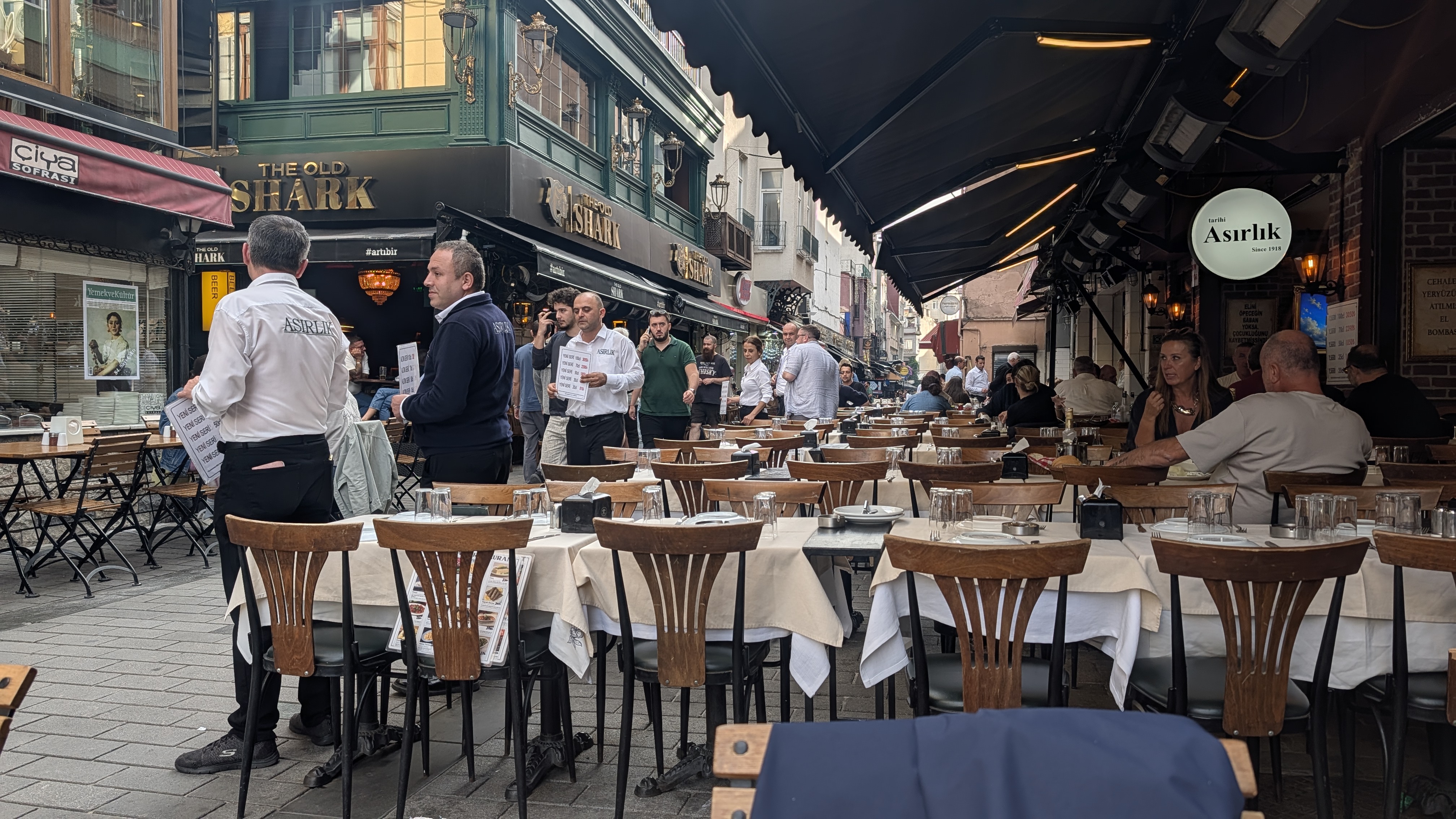
After our day in Istanbul, the conversation around our dinner table was surprisingly divided. Several people really didn't like the city. It was huge and crowded, there was an overwhelming amount to see, and figuring out how to navigate it wasn't particularly easy. They'd spent the day trying to make sense of this enormous place and came back to the ship mostly frustrated by it.
We had been in exactly the same city, on exactly the same day, and we loved it.
Our morning hadn't even gone particularly well. We went to Hagia Sophia, because of course we were going to Hagia Sophia. It's one of the places you're supposed to see in Istanbul, and I'd certainly wanted to see it. Unfortunately, there was scaffolding inside and out, tourist access was limited, and we somehow ended up being sold the wrong (and much more expensive) tickets. I'm glad I can say I've seen it, but the actual experience was mostly frustrating. If that had been the centerpiece of our day in Istanbul, I'm not sure we would have come back raving about the city either.
But Hagia Sophia wasn't really why I was excited about Istanbul. A friend of ours, Uğur, lives there, and he had taught his morning class and then taken the entire afternoon off to spend with us. He came over to the European side and met us outside the Grand Bazaar, and from there we mostly just wandered and caught up. We happened to be near the university where he'd done his undergraduate work, so he showed us around. We walked through Karaköy, where he made sure we saw some of the things we really shouldn't miss while we were there, took the funicular down, and eventually caught the ferry with him to the other side of the city.
So yes, we saw Istanbul, but mostly we spent the afternoon with our friend. We heard about his work and his family back in Ankara and talked about what it's like for him to navigate a relationship with a very conservative and religious family when he himself is agnostic. We ate lahmacun at a place he likes, sat by the water, watched people, talked some more and, naturally, I fed some cats. We saw plenty of Istanbul that afternoon, but the things I remember most aren't really sights at all.
Then there was another woman at our dinner table who had experienced yet another version of Istanbul. Unlike me, she doesn't like to do much research ahead of time. She hadn't arrived with a list of things she absolutely needed to see, so she'd opened GetYourGuide, looked for something that appealed to her and found a workshop where she could make one of the mosaic lamps we'd been seeing all over Turkey. She spent part of her day choosing the pieces, laying out her design and learning how to make the lamp, and then they carefully packaged the finished product so she could bring it home. She was absolutely delighted. It was one of the highlights of her entire trip.
Same ship, same port, same day...and three completely different Istanbuls.
I've been thinking about that ever since, because we talk about destinations as though there's a single experience waiting for us when we arrive. Is Istanbul worth visiting? What are the must-dos in Rome? How many days do I need in Athens? What should I see if I only have eight hours in port? They're perfectly reasonable questions, and I ask versions of them all the time. But they also assume that the destination itself is going to determine whether we have a great experience there, when the traveler is at least as important a part of the equation.
A few days later, our ship stopped in Katakolo, Greece, where nearly everyone we talked to was going to Olympia. That's the obvious reason for stopping there, and I'm sure many of them had a wonderful day. We didn't go. By that point we'd seen Ephesus, climbed the Acropolis, wandered the Agora and visited Philippi, with Pompeii still ahead of us. We were, frankly, a little ruined-out, and we'd already decided that what sounded much more interesting to us was the Museum of Ancient Greek Technology right there in Katakolo.
We loved every second of it. We saw inventions that repeatedly made us look at each other and quote one of our favorite lines from our friend Walker, a history professor: "People in ancient times weren't stupid." There were machines and mechanisms that seemed impossibly sophisticated, including what amounted to an automated theatrical production, and we kept finding ourselves astonished by what people had figured out thousands of years ago. We read everything, bought entirely too much from the gift shop, and then spent the rest of the afternoon telling practically everyone we encountered that they really needed to go to this museum.
Olympia may very well have been the must-do in Katakolo. It just wasn't our must-do, on that particular day, at that particular point in our trip. And I think that's the distinction I've been trying to put words around since we got home: the best trip isn't necessarily the one that gets the destination right. It's the one that gets the traveler right.
That doesn't mean the famous places aren't worth seeing. Of course they are. It doesn't mean you should skip Hagia Sophia or Olympia because we didn't particularly enjoy one and skipped the other. It means that a list of the "best" things to do in a destination can only tell you so much. One person can spend the afternoon making a mosaic lamp, another can spend it catching up with an old friend, and someone else can tour every major landmark in the city. Any one of those could be the perfect day, depending on who's having it.